First: selling to the USA or Canada is not the same as incorporating there
This distinction is extremely important.
You can have:
A business located in the United States selling to Americans and Canadians
or
A Canadian business selling to Canadians and Americans
or
A business located outside North America selling to customers in the USA and Canada.
The legal and tax consequences can be different.
This article therefore gives you the setup checklist, but you should verify your specific situation with the relevant tax authority or a qualified accountant.
Shopify also states that merchants are responsible for complying with the laws applicable to their business and customers. Before dealing with taxes, payments and legal configuration, you should already have your Shopify store, supplier, shipping settings and target markets prepared.
If you haven't completed that stage yet, go back to [Article 2: How to Find a Dropshipping Supplier and Build a Shopify Store for the USA and Canada].
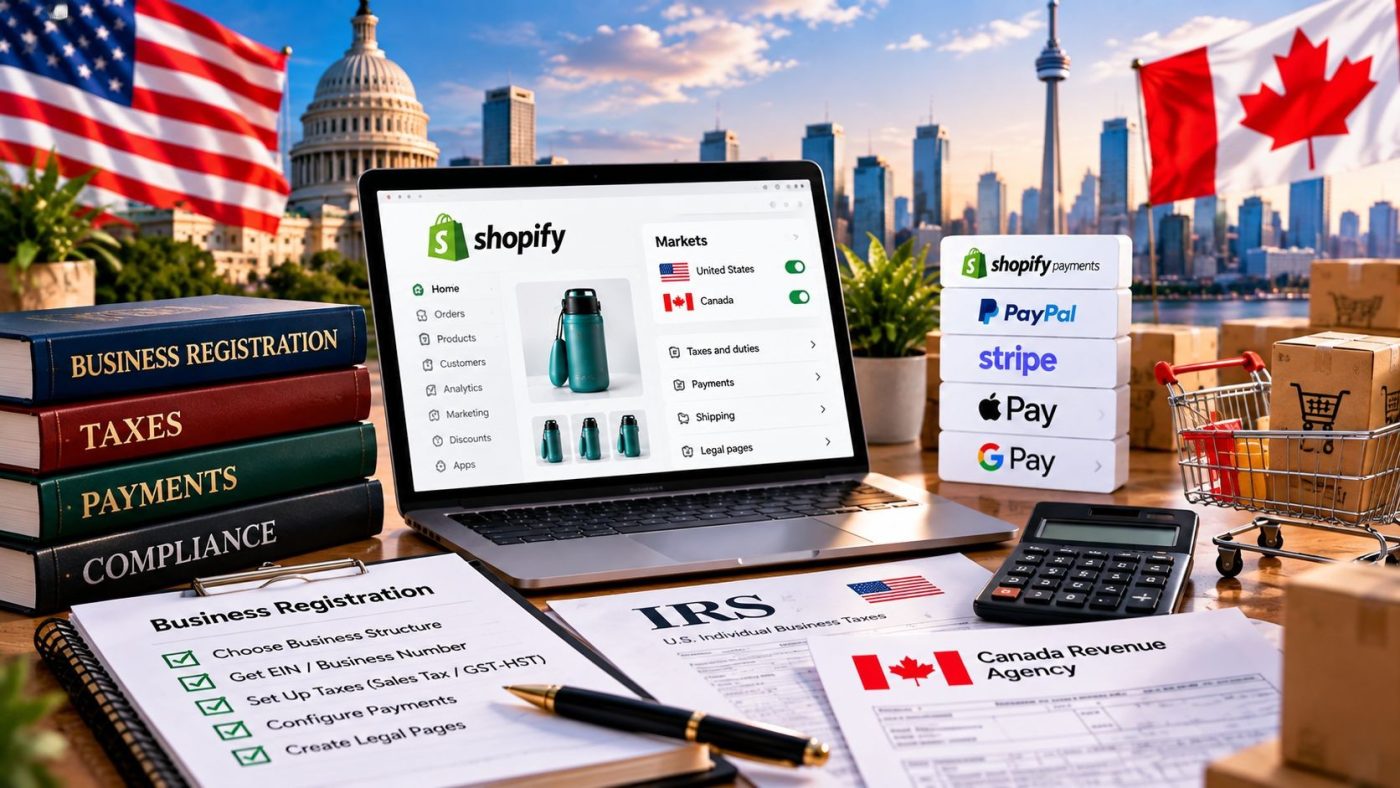
USA: Business registration
If the business is being established in the United States, start with the official US Small Business Administration resources.
U.S. Small Business Administration — Launch Your Business
The SBA's launch process covers:
choosing a business location;
choosing a structure;
choosing a name;
registering the business;
obtaining tax IDs;
licenses and permits;
business banking;
insurance.
Do not automatically choose an LLC simply because you saw it in a YouTube video.
The appropriate structure depends on your ownership, location, tax situation and circumstances.
USA: EIN
An EIN is the federal tax identification number for a business.
The SBA explains that businesses may need an EIN for purposes including federal tax administration, employees, banking and certain licensing situations.
IRS — Employer Identification Numbers
If your business is US-based, check the IRS requirements before applying.
Canada: Business Number and GST/HST
If the business is Canadian, the Canada Revenue Agency provides the official registration process.
Canada Revenue Agency — Business Registration
The CRA explains that businesses can register for a Business Number and applicable program accounts such as GST/HST.
There is an important current change:
SinceJuly 14, 2026, CRA's Business Registration Online requires access through a CRA account.
Canada: GST/HST
Don't simply enter "13%" into Shopify because you saw someone do it.
Your tax obligations depend on your business and circumstances.
Shopify's current Canadian tax documentation specifically says merchants must determine whether they should charge tax and may need to register with tax agencies before configuring Shopify.
Canada has a 5% GST, while some provinces use HST or have additional provincial sales taxes.
Step 2: Configure payments
Your checkout must accept payments from your target customers.
Depending on your business location and eligibility, this may include:
credit/debit cards;
Apple Pay;
Google Pay;
PayPal;
other supported payment methods.
The important point is:
Verify payment availability before spending money on advertising.
A store that receives 100 orders but cannot properly process payouts is not a business.
Don't Want to Handle the Technical Setup Yourself?
Following all these steps can take time, especially if you're not familiar with Shopify, payment configuration, domains, analytics, tracking, shipping settings and the technical side of running an online store.
I can handle the technical setup for you.
For$250, Bproo Dev can help you configure the technical side of your dropshipping business so you can focus on your products, customers and marketing.
Need help setting everything up?
Step 3: Configure taxes in Shopify
Go to:
Shopify Admin → Settings → Taxes and duties
Screenshot
[SCREENSHOT 1: Shopify Settings → Taxes and duties]
Shopify currently supports Shopify Tax and other tax configuration options for US and Canadian stores.
Step 4: Configure your legal pages
Create:
Shipping Policy
Refund Policy
Privacy Policy
Terms of Service
Contact page
Your shipping policy should clearly state:
processing time;
estimated delivery;
shipping regions;
shipping costs;
tracking;
delays;
customs/duties where applicable.
Do not promise:
"2–3 day delivery"
unless your supplier can actually achieve it.
Step 5: Understand US import costs
This is particularly important in 2026.
Shopify's current documentation states that, as ofAugust 29, 2025, the US de minimis exemption no longer applies to shipments to the United States, and duties/import taxes can apply regardless of shipment value. Shopify also recommends checking HS codes, country of origin and fulfillment strategy.
That means your supplier's location matters enormously.
A product fulfilled from a US warehouse can have a very different cost structure from one shipped directly into the US from overseas.
Calculate this before advertising.
Your Business Is Set Up. Now Test Everything.
Once your business structure, payments, taxes, shipping policies and legal pages are configured, don't immediately start spending money on advertising.
The next step is to test the entire customer journey — from your homepage and product page to checkout, payment, order confirmation, analytics and tracking.
Continue with [Article 4: How to Launch and Test Your Dropshipping Store in the USA and Canada].