Artificial intelligence is no longer something reserved for large technology companies.
Small businesses, freelancers and solo entrepreneurs can now use AI to handle tasks that previously required hours of manual work or expensive software.
Recent research from the Federal Reserve Bank of San Francisco found that nearly 40% of small-business respondents were already using AI or planning to use it. Common applications include productivity, marketing, SEO, written communication, graphic design, customer service, analytics and forecasting.
The important question is therefore no longer whether AI can help a small business, but rather where it can create the most practical value.
Here are 10 categories of AI tools worth exploring in 2026.
1. AI assistants for research and writing
AI assistants can help entrepreneurs:
Write emails
Summarize documents
Brainstorm ideas
Research markets
Create business plans
Rewrite marketing copy
Analyze information
Prepare meeting notes
The key is not to ask AI to "run the business."
Instead, use it as an assistant that helps you complete repetitive intellectual tasks faster.
For example, a restaurant owner could ask an AI assistant to transform customer reviews into a list of recurring complaints and possible improvements.
2. AI tools for marketing
Marketing is one of the easiest areas for a small business to improve with AI.
AI can help generate:
Social media ideas
Advertising copy
Blog outlines
Email campaigns
Product descriptions
SEO ideas
Customer personas
However, generated content should still be reviewed by a human.
The best results usually come from combining AI's speed with the company's real knowledge of its customers.
3. AI image generation
Small businesses often need images for:
Websites
Social media
Advertisements
Presentations
Product concepts
Blog posts
AI image tools can reduce the cost and time required to produce visual concepts.
For example, instead of hiring a designer for every simple social-media concept, a business can use AI to create an initial visual direction and then have a professional refine the important assets.
4. AI customer-service assistants
Customer questions can consume a surprising amount of time.
An AI-powered assistant can help answer frequently asked questions about:
Opening hours
Prices
Delivery
Products
Services
Returns
Appointments
A good implementation should not try to replace every human interaction.
Instead, it should handle repetitive questions and transfer complicated cases to a real employee.
5. AI transcription tools
Meetings, interviews and voice messages contain valuable information that is often difficult to organize.
Transcription tools can turn conversations into searchable text.
A business could use them to:
Record a meeting.
Transcribe it.
Extract decisions.
Create a task list.
Assign responsibilities.
This can turn a 60-minute meeting into a structured action plan in a few minutes.
6. AI productivity tools
AI is increasingly being integrated directly into productivity software.
Instead of switching between multiple applications, businesses can use AI features inside their existing email, document, spreadsheet and collaboration tools.
This is particularly useful for companies that already rely heavily on cloud productivity platforms.
7. AI data-analysis tools
Many small businesses already have valuable data but don't know how to use it.
Examples include:
Sales
Expenses
Inventory
Customer data
Website traffic
Advertising performance
AI-assisted analysis can help identify patterns and generate questions that deserve further investigation.
For example:
"Which products generated the highest revenue last quarter?"
can be more useful than simply looking at a spreadsheet full of numbers.
8. AI automation platforms
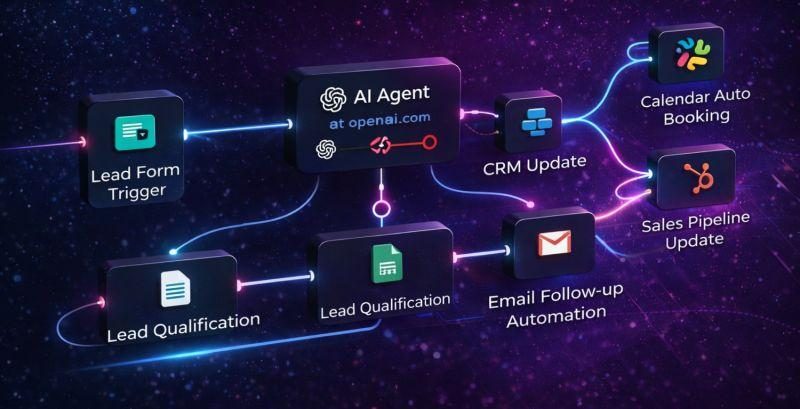
Automation becomes especially powerful when AI is connected to other business systems.
For example:
New customer form → CRM → AI summarizes request → email notification → sales task created
Another example:
New order → invoice generated → customer email sent → accounting record updated
The objective isn't to automate everything.
The objective is to eliminate repetitive steps that do not require human judgment.
9. AI coding assistants
Small businesses increasingly need custom websites, dashboards and internal applications.
AI coding assistants can help entrepreneurs and developers:
Generate code
Explain existing code
Find bugs
Write tests
Create prototypes
Build small internal tools
This doesn't eliminate the need for developers.
It can, however, significantly reduce the amount of time required to build and test certain software.
10. AI knowledge-management tools

One of the biggest problems inside growing businesses is information fragmentation.
Documents are stored in:
Email
Google Drive
Microsoft 365
WhatsApp
PDFs
Spreadsheets
CRM systems
AI-powered knowledge tools can help employees search and summarize internal information.
This becomes increasingly valuable as a company grows.
How should a small business choose an AI tool?
Don't start with:
"Which AI tool is the most powerful?"
Start with:
"Which task is wasting the most time in my business?"
Then calculate:
Time spent × frequency × cost of the employee's time
If a task takes 30 minutes every day, that's more than 10 hours per month.
Automating that task may be much more valuable than buying an expensive AI platform that nobody uses.
The biggest AI mistake small businesses should avoid
Don't implement AI simply because everyone is talking about it.
Start with one concrete workflow.
For example:
Before AI:
Customer emails → employee reads → employee writes response → employee creates follow-up task.
After AI:
Customer email → AI classifies request → suggests response → employee approves → task created.
That is a measurable improvement.
Final thoughts
AI is becoming an increasingly practical technology for small businesses.
The most useful applications aren't necessarily the most spectacular ones.
Often, the biggest gains come from simple improvements:
less repetitive work + faster communication + better information + more automation.
Start with one process, measure the result and expand gradually.